Smart calendar frames for offices
BLOG — OFFICES · TEAM CALENDARS · RECEPTION · SHARED SPACES
The paper wall planner survives in offices because it does one thing software alone does not: it makes the team's week public at a glance. A smart calendar frame keeps that public quality and deletes the Sunday-evening ritual of updating it by hand.
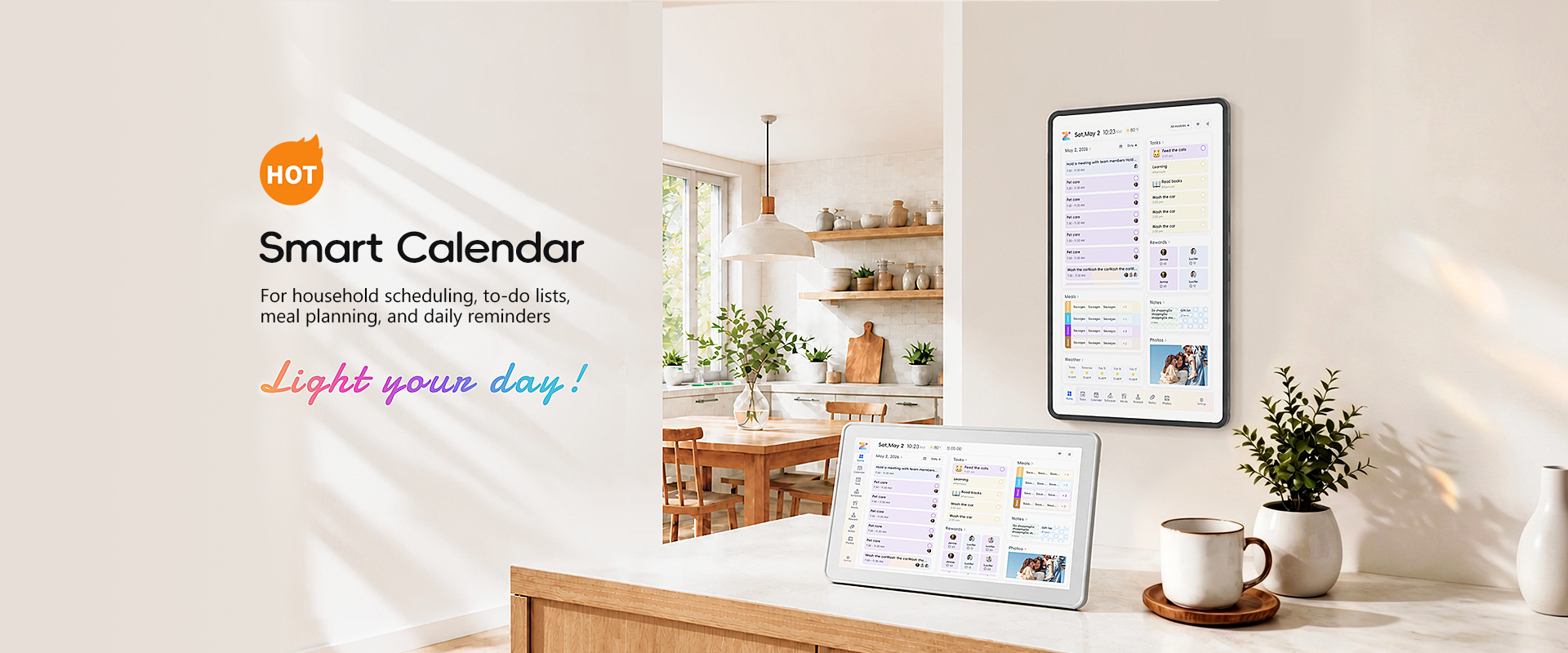
A wall calendar the whole office can read
Every office has tried to kill the wall calendar, and most have quietly kept it. Shared software calendars are better databases and worse furniture: they hide the week behind logins, tabs and personal filters, exactly where a team's shared awareness cannot afford to live. The wall planner's genius was never its paper; it was its publicity. Anyone passing could read the week — the deadlines, the visitors, the day the office empties for the offsite — without asking permission from an interface. A smart calendar frame is that planner with the data kept current automatically, which removes the only thing that was ever wrong with it.
The office use case is the reason the PF series runs to 27 inches. A frame in a home serves the people who live with it; a frame in an office serves people in motion — read from a doorway, across a desk bank, on the way to the kettle. The 21.5 and 27 inch models exist for that passing glance, and they are the sizes offices should start the conversation from.
Where offices actually put them
The placements that work share one trait: they are on a route, not in a corner. The entrance, where the day is first seen. The kitchen or coffee point, where the whole office passes at least twice. The corridor outside the meeting rooms, where the question 'is this room free, and what is in it next' is actually asked. A frame in the boss's office informs one person; a frame on the coffee route informs the company, which is the entire point of a public calendar.
Meeting-room adjacency deserves a special mention, because it solves a daily friction out of proportion to its size: the doorway negotiation over whether a room is occupied, booked or free. A calendar frame carrying the day's room schedule at the door ends the knock-and-peep era. It is usually the first placement an office chooses when it buys a second frame — the first having proved itself by the kettle.
What to put on it (and what to leave off)
A public calendar is an editorial product. The entries that belong on it are the ones the whole office benefits from knowing: deadlines, visitors, room bookings, who's away, the all-hands, the delivery expected Thursday. The entries that do not belong are the personal and the sensitive — the frame is a wall, not a diary, and teams that respect that boundary keep trusting the wall. Most offices settle into a house style within a month: team-level events on the frame, personal detail in personal calendars, and the frame's photo or information screens filling the quiet hours so the wall never looks abandoned.
Ownership matters as much here as anywhere in signage. One named person — office manager, team coordinator, whoever already owns the physical noticeboard — should own the frame's content rules. Distributed editing without an owner produces the familiar outcome: three styles, two stale months, and a slow return to the paper planner taped beside the frame it was meant to replace.
Sizing and ordering for an office
- Choose size by the farthest reading point on the route: doorway distances argue for 21.5 or 27 inches.
- Place on a route — entrance, coffee point, meeting corridor — not in a corner.
- Settle the content rules (what is public, who owns it) before the frame arrives, not after.
- For multi-floor or multi-site estates, order the sizes together so the habit is identical everywhere.
- Confirm warranty terms for the frames in your quotation.
None of this requires a facilities project. It requires a wall on a route, a calendar the team already keeps, and one person who owns the wall. The frame simply makes that arrangement keep itself up to date — which is why, a year later, offices describe the purchase as obvious in a way that most technology never manages.
The frame and the meeting-room problem
Offices that adopt calendar frames often discover a second use within a quarter: the frame by the meeting rooms becomes the room-status board the building never had. It works because the data — the day's bookings — is already calendar data, and the placement — the corridor where the question is asked — is the frame's natural habitat. Properties and offices that plan this from the start put the larger 27 inch model on the meeting corridor and the 21.5 inch on the social route; offices that discover it later simply buy the second frame, which is the same decision with a delivery delay.
What changes after a month
The honest test of a wall calendar is not the launch week, when everyone admires it, but the ordinary month that follows: does the week on the wall match the week in reality? Offices that keep the match find the frame absorbs more of the building's coordination — deliveries, visitors, the early finish on Friday — because people trust a wall that has not lied to them. Offices that let it drift teach the building to ignore it, and an ignored information surface is worse than none, because it still occupies the wall where a true one could hang.
Onboarding the building, not just the frame
Introduce the frame the way you would introduce a person who will speak for the office: tell people what it is for, who keeps it true, and what to do when it is wrong. A two-line note in the team channel and a name attached to the frame's care do more for its authority than any launch display. Buildings adopt information surfaces socially before they adopt them technically — the wall that colleagues defend in conversation is the wall that stays current, and currency, as this whole note argues, is the product.
A modest proposal for the first wall
If the idea still feels experimental, run it as one: a single 21.5 inch frame on the building's busiest route, owned by one named person, publishing one honest week at a time, reviewed after a month against a simple question — did anyone's day get easier because the wall knew the week? Offices that ask the question plainly usually end up buying the second frame for the meeting corridor, and the third for the floor above. Adoption by evidence is slower than adoption by decree, and it is the kind that survives the second year.