Dual-screen self-ordering kiosk
MODEL — 15.6 INCH DUAL-SCREEN · SELF-ORDERING · COUNTER FORMAT
The documented kiosk model in the range: a 15.6 inch self-ordering kiosk with two screens — the customer orders on one face, the operation follows on the other — sized for restaurant and quick-service counters.
At a glance
- Format
- Dual-screen self-ordering
- Screen
- 15.6 inch class
- Setting
- Restaurant · quick-service · retail counters
- Pricing
- By quotation, per configuration
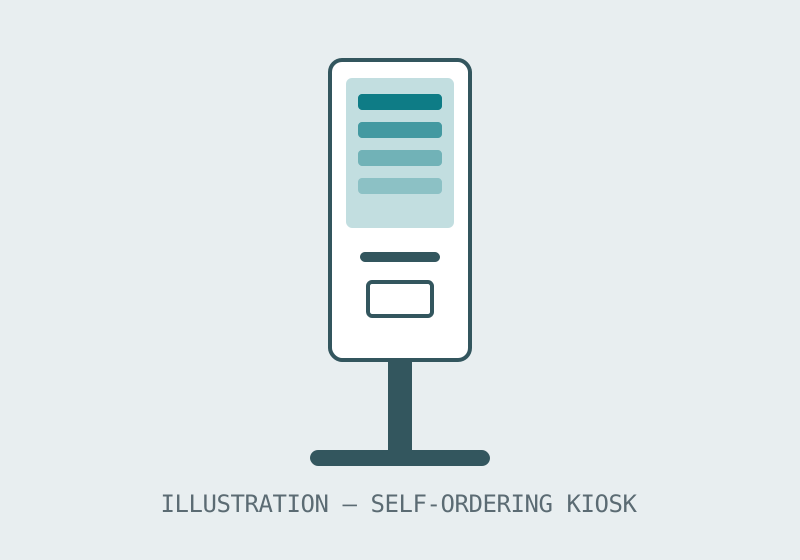
The 15.6 inch dual-screen ordering kiosk
A single-screen ordering kiosk asks the customer to order blind and the kitchen to discover the order later. The dual-screen format closes that loop at the counter: the customer builds the order on the outward screen while staff follow the same order on the inward one, catching mistakes while the customer is still standing there. At 15.6 inches the unit sits on a counter rather than dominating it, which is why this format fits the quick-service, café and bakery counters where floor-standing totems would block the room.
The manufacturer publishes this model as part of its homepage range; the category and guide pages on this site cover the kiosk family around it. What decides a working installation is rarely the screen: it is the payment route, the receipt printing and the handoff to the kitchen or the POS, and those are configuration items the inquiry exists to settle before the quotation is written.
Specification summary
| Item | Published figure |
|---|---|
| Format | Dual-screen self-ordering kiosk |
| Screen class | 15.6 inch |
| Screens | Two — customer-facing and operation-facing |
| Product family | Self-service / self-ordering kiosks |
| Full configuration | Confirmed in the quotation for your counter setup |
Published by format and screen class. Peripheral pairings — printer, payment device, scanner — are configuration choices, confirmed per order rather than printed as a fixed bundle, because counters differ more than kiosks do.
How the two screens divide the work
Think of the outward screen as the menu and the inward screen as the order ticket. The customer sees items, choices and the running total; the operation sees the order as it forms, with the chance to correct, prioritise or prepare before payment completes. In a small restaurant that visibility replaces the shouted clarification across the counter; in a chain rollout it standardises the order format that reaches the kitchen at every branch.
Placement follows from the same logic: the unit belongs where the queue forms and the staff stand behind it — the natural counter point where an order would be taken by a person today. Power and network reach that point, and the counter depth fits the footprint; both are worth confirming in the inquiry with a photograph of the counter if the project has several sites.
Counter depth, queue shape and the second unit
One kiosk at a counter changes the queue; the second changes the business. The first unit proves the flow and absorbs the confident customers; the second removes the kiosk's own queue at peak and lets the staffed till become the exception handler it should be. When you plan the first purchase, plan the position for the second — power, network and counter space reserved — even if the budget buys one today. Retrofitting the second position into a working counter is the one cost in kiosk programmes that is entirely predictable and entirely avoidable.
Before you order
- Describe the order flow the kiosk must complete, from first tap to kitchen or till.
- List the peripherals — printer, payment device, scanner — the quotation should include.
- Tell us your target quantity and configuration so we can confirm the minimum order for your project.
- Confirm warranty terms for your model in your quotation.